Driveway and Sidewalk Cleaning Tips for a Polished Home Exterior
Reading time: 12 minutes
You pull into your driveway after a long day, and something feels… off. The concrete is stained with tire marks, the sidewalk is coated in a thin layer of grime, and a patch of stubborn moss has decided to make itself comfortable in the cracks near your front door. Sound familiar? You’re not alone—and the good news is, transforming your home’s exterior doesn’t require a professional crew or an expensive overhaul.
Here’s the straight talk: A clean driveway and sidewalk can boost your home’s curb appeal by up to 10%—which translates into real monetary value if you’re thinking about resale. But beyond dollars and cents, a polished exterior is simply a matter of pride and safety. Slippery moss, oil stains, and crumbling concrete aren’t just eyesores—they’re hazards.
In this guide, we’ll walk you through everything from choosing the right cleaning method to tackling the toughest stains—with practical, step-by-step advice for both beginners and seasoned DIYers.
Table of Contents
- Why Driveway and Sidewalk Cleaning Matters in 2026
- Choosing the Right Tools and Methods
- Pressure Washing: The Gold Standard
- Tackling Tough Stains Like a Pro
- Eco-Friendly Cleaning Solutions
- Seasonal Maintenance: A Smart Year-Round Strategy
- Cleaning Method Comparison Table
- Effectiveness Data: Cleaning Methods at a Glance
- Real-World Case Studies
- FAQs
- Your Exterior Cleaning Roadmap: Next Steps
Why Driveway and Sidewalk Cleaning Matters in 2026
We live in an era of heightened home awareness. Since the post-pandemic housing boom reshaped how people relate to their living spaces, homeowners in 2026 are investing more intentionally in exterior maintenance. According to a National Association of Realtors report published in early 2026, homes with well-maintained exteriors sell 7–10% faster than comparable properties with neglected curb appeal.
But it’s not just about resale. Municipal codes in many U.S. cities and Canadian provinces have been updated through 2025 to include sidewalk cleanliness ordinances—meaning a dirty or algae-covered sidewalk can now result in fines in some jurisdictions. In 2026, cities like Portland, Denver, and Toronto have all reinforced regulations that hold homeowners responsible for the condition of the sidewalk adjacent to their property.
Beyond compliance and aesthetics, there’s a safety dimension that’s easy to overlook:
- Algae and moss create dangerously slippery surfaces, especially after rain.
- Oil stains on driveways can leach into groundwater if left untreated.
- Cracked, dirty concrete deteriorates faster, costing you more in long-term repairs.
Think of regular cleaning not as a chore but as preventive maintenance—the same way you’d service your car before a breakdown, not after.
Choosing the Right Tools and Methods
Before you dive in with a hose and some dish soap, take a moment to assess your surface type and the nature of the staining. Not all driveways are created equal—and using the wrong method can cause more harm than good.
Surface Types and Their Cleaning Needs
Different surfaces demand different approaches. Here’s a quick breakdown of the most common driveway and sidewalk materials you’ll encounter:
- Concrete: Durable and widely used, but porous—meaning it absorbs oil, rust, and organic matter easily. Responds well to pressure washing and alkaline cleaners.
- Asphalt: More flexible than concrete but sensitive to harsh chemical cleaners. Requires gentler pressure and pH-neutral solutions.
- Pavers (brick or stone): Beautiful but susceptible to joint sand erosion from high-pressure washing. Requires careful technique and re-sanding after deep cleaning.
- Stamped concrete: Sealed surfaces that can be damaged by high PSI. Use lower pressure and a fan-tip nozzle.
- Exposed aggregate: Textured surface that traps debris easily. Benefits from a rotating surface cleaner attachment.
Essential Tools to Have on Hand
Building your cleaning toolkit doesn’t have to be expensive. Here’s what you actually need—prioritized by impact:
- Pressure washer (electric or gas-powered): The single most effective tool for most surfaces. Electric models (1,500–2,000 PSI) are ideal for residential use. Gas models (2,500–4,000 PSI) are better for heavy-duty jobs.
- Surface cleaner attachment: A rotating head that provides even cleaning without streaking—a must-have for large flat surfaces.
- Stiff-bristle brush: Essential for working cleaning solutions into porous concrete before rinsing.
- Garden hose with spray nozzle: For rinsing and lighter maintenance cleaning.
- Concrete degreaser or alkaline cleaner: Specifically formulated to break down oil-based stains without damaging the surface.
- Sealer (optional but recommended): Applied after deep cleaning to protect against future staining.
Pro Tip: In 2026, cordless electric pressure washers with battery technology have improved dramatically—brands like Greenworks and EGO now offer models with up to 2,000 PSI that rival entry-level gas units. Great for eco-conscious homeowners who want portability without emissions.
Pressure Washing: The Gold Standard
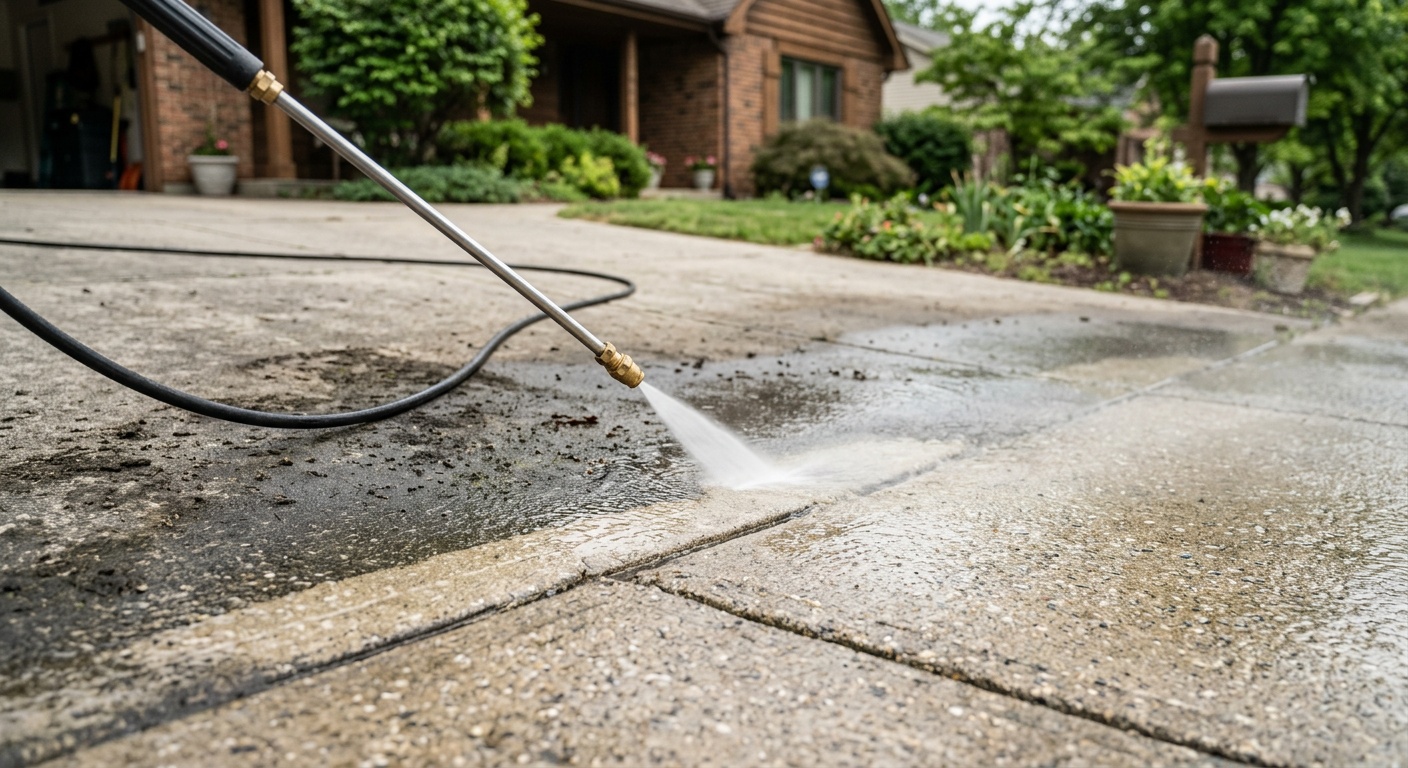
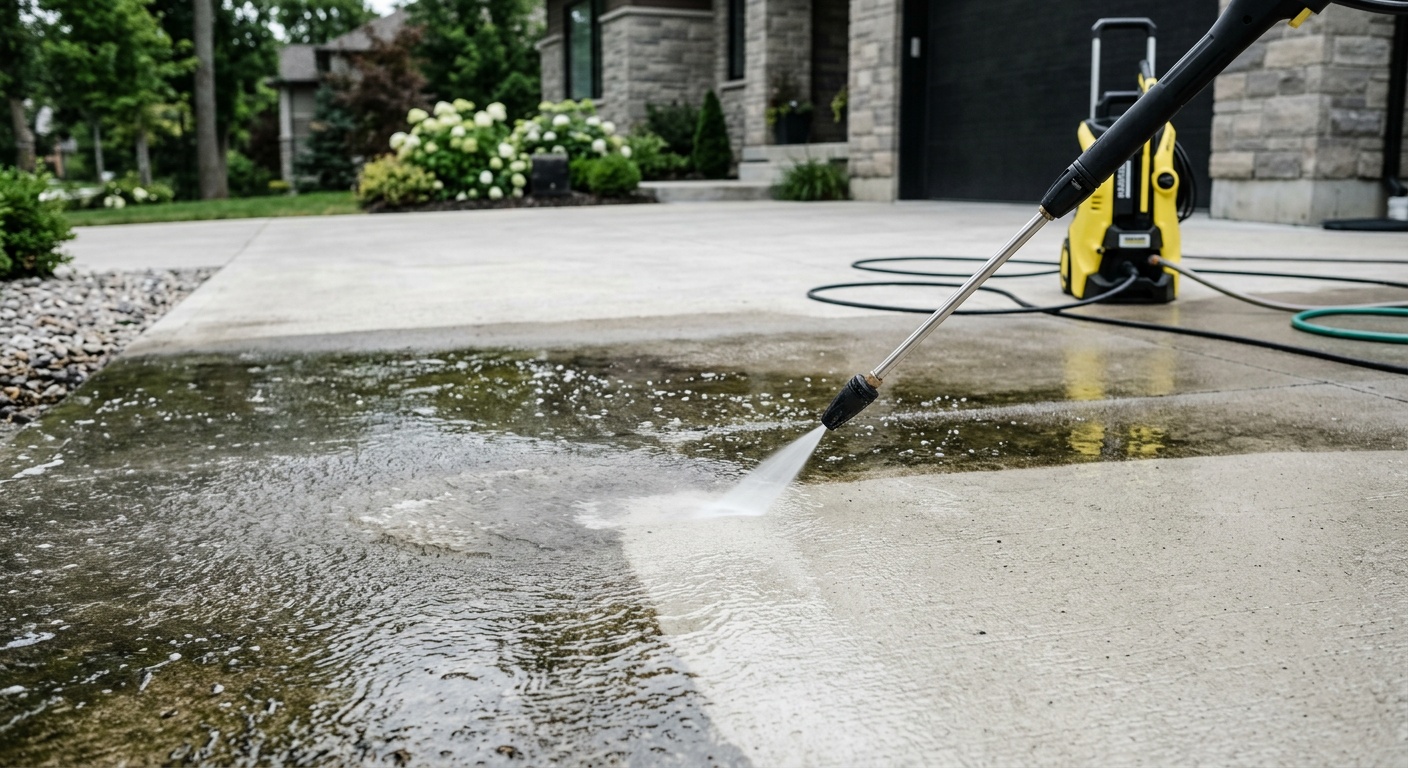
If cleaning your driveway were a sport, pressure washing would be the championship move. Done correctly, it removes years of embedded dirt, biological growth, and light staining in a fraction of the time it would take with manual scrubbing.
But “done correctly” is the operative phrase. Here’s a step-by-step process that professionals use—and that you can replicate at home:
- Clear the area: Remove vehicles, potted plants, garden hoses, and any loose debris. Sweep away loose dirt and leaves first—this prevents clogging your pressure washer’s intake.
- Pre-treat stains: Apply a concrete degreaser or a dedicated cleaner to oil spots and let it dwell for 10–15 minutes before washing.
- Choose the right nozzle: Use a 25-degree (green) nozzle for general cleaning on concrete. Use a 40-degree (white) nozzle for more delicate surfaces like pavers or stamped concrete. Never use a 0-degree (red) nozzle on residential surfaces—it can etch the concrete.
- Maintain consistent distance: Hold the wand 6–12 inches from the surface. Too close causes etching; too far reduces effectiveness.
- Work in overlapping passes: Use smooth, sweeping motions and overlap each pass by about 30% to avoid streaking.
- Rinse thoroughly: Always finish with a clean water rinse to remove any remaining cleaner residue.
- Allow to dry completely: Wait 48–72 hours before applying any sealer.
Common mistake to avoid: Many homeowners pressure wash toward their home’s foundation. Always direct water away from the house to prevent moisture infiltration into your basement or crawl space.
Tackling Tough Stains Like a Pro
Every driveway tells a story—and sometimes that story includes a transmission fluid leak, a bag of fertilizer that spilled two summers ago, or a streak of rust from a metal chair left out in the rain. Here’s how to address the most common offenders:
Oil and Grease Stains
These are the nemesis of concrete driveways. Fresh oil stains are far easier to deal with than old, set-in ones.
- Fresh stains: Absorb as much as possible immediately with cat litter or baking soda. Let it sit for 30 minutes, sweep, then apply a degreaser.
- Old stains: Apply a commercial alkaline degreaser (like Zep or Simple Green Concrete Cleaner), scrub with a stiff brush, and let dwell for 20–30 minutes. Follow with hot water pressure washing at 2,000–2,500 PSI.
- Stubborn set stains: Try a poultice of TSP (trisodium phosphate) mixed with diatomaceous earth, applied overnight and rinsed the next morning.
Rust Stains
Rust on concrete is oxidized iron—it requires an acid-based cleaner to break the bond. Products containing oxalic acid (like Bar Keepers Friend) work well. Apply, scrub, and rinse. Avoid muriatic acid unless you’re experienced—it’s highly corrosive and can damage concrete if misused.
Moss, Algae, and Mildew
In 2026, biological growth on exterior surfaces is an increasingly common problem in many regions due to shifting precipitation patterns. To address it:
- Apply a diluted bleach solution (1 part bleach to 10 parts water) or a dedicated algaecide to affected areas.
- Let it sit for 15–20 minutes, then scrub and rinse.
- For prevention, consider applying a penetrating sealer with mold-inhibiting properties.
Important note: Never mix bleach with ammonia-based cleaners. This creates toxic chloramine gas—a serious safety hazard.
Eco-Friendly Cleaning Solutions
With increased environmental awareness in 2026, many homeowners are rightfully concerned about the chemicals they’re washing into storm drains. The good news: effective cleaning doesn’t have to mean harsh chemicals.
Here are proven eco-friendly alternatives:
- White vinegar: A mild acid effective against mineral deposits and light biological growth. Use undiluted on affected areas and let sit for 30 minutes before scrubbing.
- Baking soda paste: Mix with water to form a paste for gentle scrubbing of surface-level stains.
- Oxygen bleach (sodium percarbonate): An effective, biodegradable alternative to chlorine bleach. Safe for most surfaces and breaks down harmlessly in water.
- Plant-based degreasers: Brands like Simple Green and Seventh Generation offer concentrated formulas that are phosphate-free and environmentally responsible.
Also consider the volume of water you’re using. A standard garden hose uses about 140 gallons per hour; a pressure washer uses only 3–8 gallons per minute at much higher effectiveness. Counterintuitively, pressure washing is often the more water-efficient option when compared to extended hose-and-brush scrubbing sessions.
Seasonal Maintenance: A Smart Year-Round Strategy
One of the biggest mistakes homeowners make is treating driveway cleaning as a once-a-year spring project. A smarter approach accounts for the seasonal challenges each time of year brings.
- Spring: Deep clean after winter. Remove salt residue (which degrades concrete), sweep away debris, and inspect for cracks caused by freeze-thaw cycles. Fill cracks with concrete caulk or filler before they expand.
- Summer: Ideal for sealing. Apply a penetrating or film-forming concrete sealer after your spring clean-up to protect through the high-use months. Watch for tire marks from hot asphalt tracking.
- Fall: Sweep leaves frequently—decomposing leaves stain concrete and create slippery hazards. Pressure wash before temperatures drop to ensure surfaces are clean going into winter.
- Winter: Use calcium chloride instead of rock salt for de-icing—it’s less corrosive to concrete and more effective at lower temperatures. Avoid metal shovels that can scratch and chip surfaces.
Cleaning Method Comparison Table
| Method | Effectiveness | Cost (Approx.) | Eco-Friendliness | Best For |
|---|---|---|---|---|
| Pressure Washing | ★★★★★ | $150–$400 (rental or purchase) | Moderate (low water use) | General deep cleaning |
| Chemical Degreaser | ★★★★☆ | $10–$30 per application | Low–Moderate | Oil and grease stains |
| Oxygen Bleach | ★★★★☆ | $15–$25 per treatment | High | Mold, mildew, organic stains |
| Manual Scrubbing | ★★☆☆☆ | Minimal ($5–$15 for brush) | High | Small spot treatments |
| Professional Service | ★★★★★ | $150–$400 per visit | Variable | Large areas, restoration work |
Effectiveness Data: Cleaning Methods at a Glance
The following chart represents homeowner-reported satisfaction rates (out of 100%) for each cleaning method, based on a 2025 survey by HomeAdvisor Pro Insights:
Real-World Case Studies
Case Study 1: The Suburban Transformation in Columbus, Ohio
In spring 2025, a homeowner in Columbus decided to put their 1990s split-level on the market. The driveway—a 1,200-square-foot expanse of concrete—was covered in years of oil stains, tire marks, and biological growth. Their real estate agent suggested cleaning and sealing before listing.
Using a rented 3,000 PSI gas pressure washer, a commercial alkaline degreaser for the oil stains, and a two-step oxygen bleach treatment for the biological growth, the homeowner spent one weekend and roughly $85 in supplies (plus a $60 rental fee) to restore the driveway. After applying a penetrating concrete sealer, the surface looked nearly new.
Result: The home sold within 11 days of listing—at $8,000 above asking price. The agent specifically cited the clean exterior as a key factor in first-impression impact.
Case Study 2: The Eco-Conscious Approach in Portland, Oregon
A Portland homeowner in 2026 wanted to clean their paver walkway and sidewalk without using any chlorine-based products—motivated by the city’s updated stormwater regulations limiting chemical runoff. They opted for a combination of white vinegar treatments (for moss and algae) and an oxygen bleach soak for general discoloration.
The process was slower—requiring two treatment cycles over two weekends—but the results were nearly equivalent to a chemical treatment. Importantly, the homeowner avoided any potential fines under Portland’s updated 2025 stormwater ordinance and maintained the integrity of the joint sand between their pavers.
Lesson learned: Eco-friendly methods work—but require more patience and often multiple applications. Plan for a longer timeline if you’re going chemical-free.
Frequently Asked Questions
How often should I clean my driveway and sidewalk?
For most homeowners, a thorough deep clean once or twice a year is sufficient—ideally in spring (post-winter) and fall (pre-winter). However, high-traffic driveways, areas with significant tree cover, or surfaces in humid climates may benefit from quarterly maintenance cleanings. Spot-treat oil stains or biological growth as soon as you notice them to prevent permanent staining.
Is it worth sealing my driveway after cleaning?
Absolutely—and most professionals consider sealing a non-negotiable step after deep cleaning. A quality penetrating sealer reduces porosity, making your concrete or paver surface far more resistant to future oil stains, water damage, and freeze-thaw cracking. Concrete driveways should be resealed every 2–3 years; asphalt driveways typically need resealing every 1–2 years. The cost of sealing is almost always less than the cost of repairing a deteriorated surface.
Can I damage my driveway by pressure washing it incorrectly?
Yes—and it’s more common than you’d think. Using too high a PSI (over 3,000 on standard residential concrete), holding the wand too close to the surface, or using a 0-degree nozzle can etch or pit concrete and erode the joint sand in paver installations. Always start with a lower pressure setting and test a small inconspicuous area first. For stamped or decorative concrete, stay at or below 1,500 PSI and use a 40-degree fan tip.
Your Exterior Cleaning Roadmap: Next Steps
You now have everything you need to move from a stained, neglected driveway to a surface that makes the whole street look better. Here’s your practical action plan—designed to be tackled in order over the coming weeks:
- Assess your surfaces this weekend: Walk your driveway and sidewalk and identify problem areas—oil stains, cracks, biological growth, salt damage. Take photos so you can track your progress.
- Gather your tools: Decide whether to rent or buy a pressure washer based on your project scope. Purchase appropriate cleaners for your specific stain types. Budget $60–$120 for a well-equipped cleaning kit.
- Schedule a deep clean day: Pick a dry day with temperatures above 50°F (10°C). Allow a full day for a 2-car driveway and adjacent sidewalk—including pre-treatment, washing, and rinsing.
- Seal within two weeks of cleaning: Once surfaces are fully dry (48–72 hours minimum), apply a penetrating sealer. This step locks in your investment and extends your cleaning results by 2–3 years.
- Build a seasonal maintenance habit: Set a calendar reminder for spring and fall light maintenance cleans. Five minutes of spot treatment saves hours of deep cleaning later.
Key takeaways to keep in mind:
- Your surface type determines your method—never use the same approach on asphalt that you’d use on concrete.
- Pre-treatment of stains before pressure washing dramatically improves results.
- Eco-friendly options are genuinely effective—they just require more time and sometimes multiple applications.
- Sealing is the difference between cleaning once a decade and cleaning once a year.
- Seasonal maintenance prevents the accumulation of damage that becomes expensive to reverse.
As smart home technology and exterior maintenance apps continue to evolve in 2026, some homeowners are already using AI-powered diagnostic tools that can analyze photos of their driveway and recommend the optimal cleaning regimen. It’s a glimpse into a future where maintaining your home’s exterior becomes as data-driven as managing its energy use.
But for now, here’s the question worth sitting with: What is the current state of your driveway saying about the home behind it—and is that the impression you want to make? Your exterior is your home’s first handshake with the world. Make it a confident one.