How to Boost Your Home’s Curb Appeal on Any Budget
Reading time: 12 minutes
Ever driven past a house that stopped you in your tracks? Maybe it was the crisp paint, the lush landscaping, or just a certain je ne sais quoi that made the whole property feel alive. Now glance back at your own front door and ask yourself honestly: does your home make that kind of impression?
Here’s the straight talk: curb appeal isn’t just about vanity. In 2026, with the U.S. housing market remaining fiercely competitive—median home values hovering around $415,000 according to recent Zillow data—first impressions carry real financial weight. A National Association of Realtors study found that homeowners who invested in curb appeal improvements recouped up to 109% of their costs at resale. That’s not decoration. That’s strategy.
Whether you’re working with $50, $500, or $5,000, this guide will walk you through every practical step to transform your home’s exterior from forgettable to unforgettable.
Table of Contents
- Why Curb Appeal Matters More Than Ever in 2026
- Quick Wins: Budget Under $100
- Mid-Range Moves: $100–$1,000
- Major Upgrades: $1,000 and Above
- Seasonal Strategy: Keeping It Fresh Year-Round
- Curb Appeal ROI at a Glance
- Project Comparison Table
- FAQs
- Your Curb Appeal Action Plan
Why Curb Appeal Matters More Than Ever in 2026
The way people discover homes has fundamentally changed. In 2026, more than 97% of homebuyers begin their search online, according to the National Association of Realtors’ 2025 Profile of Home Buyers and Sellers. That means before anyone steps foot on your property, your home’s exterior has already been judged—often in under three seconds—through a smartphone screen.
But curb appeal isn’t just for sellers. Homeowners who invest in their home’s exterior report higher satisfaction with their living environment, stronger community pride, and even improved mental well-being. A 2025 study published in the Journal of Environmental Psychology found that residents living in neighborhoods with high exterior aesthetic scores reported 23% lower stress levels than those in visually neglected neighborhoods.
The Psychology of First Impressions
Think about how you feel walking into a well-kept hotel lobby versus a dingy motel corridor. Your home’s exterior triggers the same neurological response in visitors, potential buyers, and even yourself. Psychologists refer to this as the halo effect—when something looks well-maintained on the outside, we unconsciously assume everything on the inside is equally well cared for.
Real estate agent Maria Delgado of Austin, Texas, puts it bluntly: “I’ve had buyers decide against touring a home purely based on the driveway and front garden. I’ve also had buyers fall in love before they even rang the doorbell. The exterior sets the entire emotional tone of the visit.”
Understanding Your Starting Point
Before you spend a single dollar, walk to the end of your driveway or street and look at your home with fresh eyes. Better yet, take a photograph and study it on your phone—the camera lens is far more objective than your own habituation to familiar surroundings. Ask yourself:
- Is the paint faded, peeling, or outdated in color?
- Are the garden beds overgrown, sparse, or nonexistent?
- Does the front door feel welcoming and intentional?
- Is the driveway cracked, stained, or weed-invaded?
- Are gutters sagging or downspouts misaligned?
- Does the lighting create a warm ambiance at night?
Identify your biggest pain points first. The most budget-conscious approach is always to fix what’s broken before adding what’s new.
Quick Wins: Budget Under $100
You don’t need a renovation budget to make a remarkable difference. Some of the highest-impact curb appeal improvements cost nothing more than time and elbow grease. Let’s start where anyone can start.
The Power of Clean
In 2025, a pressure washing company in suburban Chicago conducted an informal experiment: they photographed 20 homes before and after a professional pressure wash of driveways and walkways—no other changes made. When shown the before-and-after pairs to a panel of 50 strangers, 92% rated the post-wash homes as “significantly more appealing.” The average cost of that transformation? $75 for a DIY electric pressure washer rental.
Here’s what a sub-$100 curb appeal blitz looks like:
- Pressure wash driveways, walkways, siding, and the front porch. Rent a unit for $40–$70/day.
- Clean gutters and ensure downspouts are properly directed away from the foundation.
- Edge the lawn along walkways and garden beds for a crisp, intentional look.
- Weed garden beds thoroughly. A clean, mulched bed with no plants still looks better than an overgrown one.
- Wash windows inside and out—dirty glass dulls the whole facade.
- Replace house numbers with modern, easy-to-read options. A set of brushed nickel or matte black numbers costs $15–$30 and signals attention to detail.
- Add a new welcome mat ($15–$25) and a potted plant ($10–$20) flanking the front door.
Quick Scenario: Imagine you’re preparing your home for sale in 30 days with almost no budget. This $100 cleanup routine, done diligently over a weekend, could realistically increase your listing’s online click-through rate by attracting more interest—a fact supported by Redfin’s 2025 listing analytics, which showed clean, bright exterior photos generated 41% more showing requests than dark or cluttered ones.
Mid-Range Moves: $100–$1,000
Once the fundamentals are clean, strategic investments in the $100–$1,000 range begin to deliver serious visual and financial returns. This is where you start sculpting your home’s personality.
Front Door Transformation
If your home’s face has a focal point, it’s the front door. In 2026, the most popular front door colors—according to Sherwin-Williams’ annual color trend report—include deep navy, forest green, terracotta, and warm black. These bold choices create contrast and visual interest against neutral siding colors that dominate most American neighborhoods.
A gallon of high-quality exterior paint costs $45–$65. Add new hardware—a statement door knocker, a deadbolt with a polished finish, and a matching kickplate—for another $80–$150, and your front door can look like it belongs on a magazine cover for under $250 total.
Case Study: Jessica and Tom Harrington of Nashville updated their 1998 colonial-style home’s forest green door to a rich terracotta in early 2025. They added oil-rubbed bronze hardware and a new coach-style porch light. Total spend: $340. When they listed the property six months later, their real estate agent credited the exterior updates—along with other improvements—as a key factor in receiving three offers within the first weekend.
Landscaping That Does the Work for You
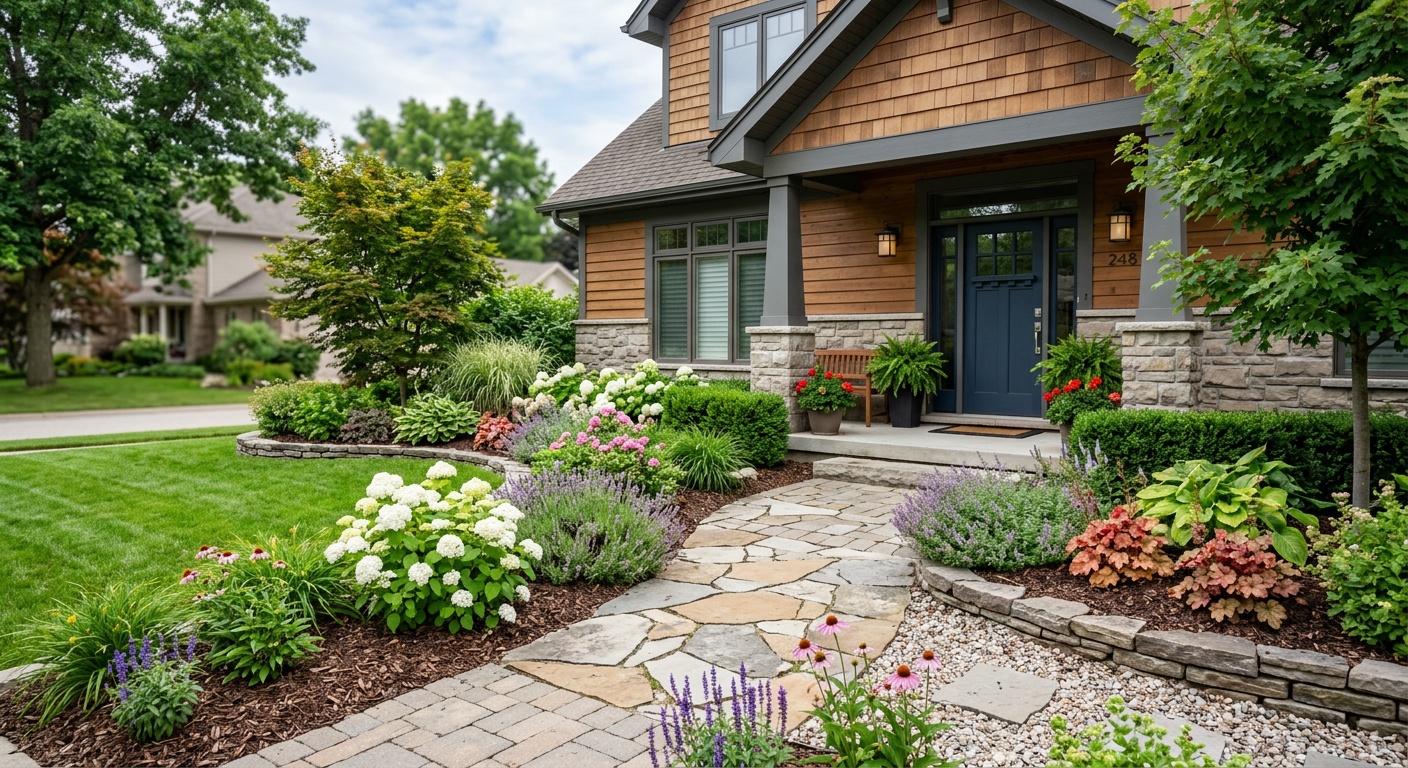
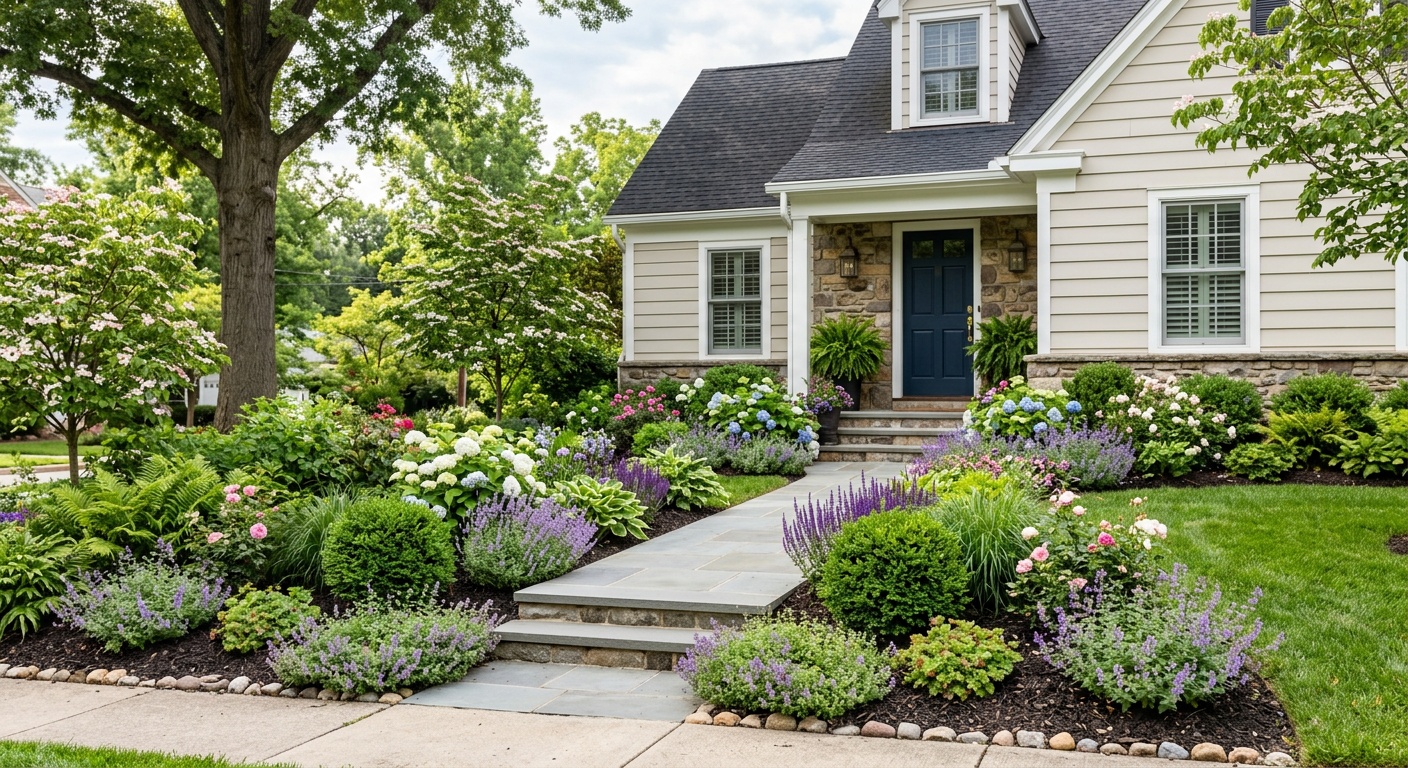
You don’t need a professional landscape architect to design a compelling garden bed. The secret is layering: tall plants in the back, medium shrubs in the middle, low ground cover in the front. Choose plants native to your region for lower maintenance and higher survival rates.
In 2026, low-water native landscaping continues its surge in popularity, driven both by water conservation regulations in the Sun Belt states and a broader eco-conscious consumer trend. In California, Arizona, and Texas, replacing a traditional grass lawn with drought-tolerant landscaping (known as xeriscaping) can save homeowners $500–$1,200 annually in water bills while dramatically increasing curb appeal.
For a $200–$400 budget, consider:
- A fresh 2-inch layer of mulch in all garden beds (dramatically improves perceived maintenance)
- Three to five mid-size flowering shrubs anchoring the bed edges
- Seasonal annuals in pots flanking the front door for color and cheer
- Ornamental grasses for low-maintenance texture and year-round interest
Lighting: The Underestimated Differentiator
Exterior lighting is one of the most overlooked curb appeal investments, yet it works around the clock—even in the evening when many buyers drive neighborhoods to shortlist homes. Solar-powered pathway lights ($30–$80 for a set) and a new porch fixture ($60–$150) can completely redefine your home’s nighttime presence.
For a more dramatic effect, consider low-voltage landscape spotlights angled upward at mature trees or architectural features. These create shadow and dimension that photographs beautifully and looks stunning in person. A starter kit runs approximately $80–$120 and can be installed in an afternoon without an electrician.
Major Upgrades: $1,000 and Above
When you’re ready to make transformational changes, larger budget projects deliver the biggest visual leaps—and in many cases, the strongest return on investment at resale.
Exterior Painting: The Single Highest-Impact Upgrade
A full exterior repaint is consistently ranked by real estate professionals as the number one curb appeal investment for homes that need it. According to Remodeling Magazine’s 2025–2026 Cost vs. Value Report, exterior painting delivers an average ROI of 51%—meaning for every $3,000 you spend, you recover roughly $1,530 in added home value. That’s not counting the psychological value of living in a home you’re genuinely proud of.
Professional exterior painting costs vary significantly by region and home size:
- Small home (under 1,500 sq ft): $2,500–$4,500
- Medium home (1,500–2,500 sq ft): $4,000–$7,000
- Large home (2,500+ sq ft): $6,500–$12,000+
If the budget is tight, a strategic approach is to paint only the trim and front facade while leaving the sides and back for a future project. This focused investment delivers 80% of the visual impact at roughly 30% of the cost.
Driveway Repair and Replacement
A cracked, stained, or sunken driveway is one of the most damaging curb appeal issues—and one of the most frequently overlooked by homeowners who have grown accustomed to it. Sealing a concrete or asphalt driveway costs $300–$600 and can dramatically improve appearance and longevity. Full replacement of a standard two-car asphalt driveway runs $3,000–$7,000 but offers strong ROI in high-value markets.
An increasingly popular alternative in 2026 is permeable paver systems, which combine aesthetic appeal with environmental functionality by allowing rainwater to absorb into the ground rather than running off into storm drains. These systems cost $8,000–$15,000 for a standard driveway but qualify for green building tax credits in many states and significantly elevate a property’s premium feel.
Garage Door Replacement
Here’s an often-cited statistic that surprises homeowners: garage door replacement consistently ranks as one of the highest-ROI home improvement projects according to Remodeling Magazine—delivering 93–194% return on investment in 2025. Why? Because the garage door often comprises 30–40% of a home’s total visible facade. An outdated or damaged garage door can single-handedly drag down the entire exterior aesthetic.
Modern steel garage doors with woodgrain texture overlays or glass panel inserts run $1,200–$3,500 installed, depending on size and style. Carriage house designs remain the top seller in 2026, aligning with the continued consumer preference for traditional-with-modern-twist architecture.
Seasonal Strategy: Keeping It Fresh Year-Round
Curb appeal isn’t a one-time project—it’s an ongoing conversation between your home and the world. Developing a seasonal maintenance rhythm ensures your investment compounds over time rather than deteriorating between major upgrades.
- Spring: Refresh mulch, plant warm-season annuals, power wash hardscapes, inspect paint for winter damage.
- Summer: Maintain lawn irrigation, deadhead flowers, clean driveway, touch up paint where needed.
- Fall: Plant spring-blooming bulbs, rake and compost leaves, inspect and clean gutters, update porch decor for warmth.
- Winter: Use evergreen wreaths and string lighting to maintain warmth and visual interest; ensure walkways are clear and well-lit.
Pro Tip: Set a recurring calendar reminder each season to do a quick 15-minute exterior audit. Walk the perimeter with fresh eyes (or that smartphone camera trick again). Catching small issues early prevents them from becoming expensive problems—and keeps your home perpetually photo-ready.
Curb Appeal ROI at a Glance
The chart below illustrates the approximate return on investment for common curb appeal projects, based on aggregated 2025–2026 data from Remodeling Magazine, NAR, and HomeAdvisor.
Curb Appeal Project ROI Comparison (2026)
Sources: Remodeling Magazine Cost vs. Value 2025–2026, NAR, HomeAdvisor
Project Comparison: Finding Your Best Investment
Use this table to match curb appeal projects to your budget, timeline, and goals:
| Project | Avg. Cost | DIY Friendly? | ROI Estimate | Time to Complete |
|---|---|---|---|---|
| Pressure Washing | $40–$150 | Yes | High (visual impact) | Half-day |
| Front Door Repaint + Hardware | $150–$350 | Yes | 74% | 1–2 days |
| Landscaping Refresh | $300–$1,500 | Partially | 109% | 1–3 weekends |
| Exterior Repaint (Full) | $3,000–$9,000 | Challenging | 51% | 3–7 days (pro) |
| Garage Door Replacement | $1,200–$3,500 | No | 194% | 1 day (pro install) |
Frequently Asked Questions
How much does curb appeal actually affect home sale price?
Quite significantly, according to multiple studies. A 2025 analysis by the University of Texas found that strong curb appeal added an average of 7–14% to a home’s sale price compared to similar homes on the same street with below-average exteriors. In a $400,000 market, that’s a potential difference of $28,000–$56,000—a figure that dwarfs the investment required to improve your exterior. Even in non-sale contexts, better curb appeal correlates with faster sales, stronger negotiating power, and higher appraised values for refinancing purposes.
What are the best curb appeal improvements for renters or those with landlords?
Renters have more options than most people realize. Focus on moveable, non-permanent enhancements: large potted plants and window boxes, a stylish welcome mat, updated porch furniture, solar-powered pathway lights staked into the ground, and seasonal wreath displays on the front door. These investments travel with you when you move and require no landlord approval in most cases. Always review your lease for any exterior modification clauses before making any permanent changes, even minor ones.
Is it worth hiring a professional landscaper or designer for curb appeal projects?
For homeowners with larger budgets or homes in premium markets, a one-time consultation with a landscape designer (typically $150–$500 per hour) can pay for itself many times over by preventing costly mistakes and creating a cohesive plan you execute over time at your own pace. Many designers in 2026 now offer virtual consultations for as little as $99, where you share photos and receive a detailed planting and layout plan. For simpler projects—mulching, basic plantings, lawn edging—DIY is absolutely achievable with a solid weekend and YouTube as your guide.
Your Curb Appeal Action Plan: From Overlooked to Outstanding
Here’s the truth that ties everything together: curb appeal isn’t about perfection. It’s about intentional progression. You don’t need to transform your home in a weekend. You need a clear, budget-calibrated sequence that builds momentum and compounds results over time.
In 2026, with AI-powered home valuation tools, drone photography for real estate listings, and neighbor review platforms becoming mainstream, your home’s exterior is being evaluated more frequently—and more precisely—than ever before. The homeowners winning in this environment aren’t the ones with the biggest budgets. They’re the ones who are consistently attentive.
Here’s your practical roadmap, regardless of where you’re starting from:
- This weekend (free–$100): Deep clean the entire exterior. Pressure wash, edge the lawn, clear dead plants, clean windows, and take a photograph from the street for your reference baseline.
- This month ($100–$500): Tackle the highest-impact cosmetic fixes—fresh door paint, new hardware, updated house numbers, and a mulch refresh in garden beds.
- This season ($500–$1,500): Add strategic landscaping, improve outdoor lighting, and repair any visible structural issues like cracked walkways or sagging gutters.
- This year ($1,500+): Evaluate your biggest structural curb appeal gaps—garage door, full repaint, or driveway—and plan the investment that delivers maximum ROI for your market and goals.
- Ongoing: Build a seasonal maintenance calendar and revisit your exterior with fresh eyes every three months. Consistent small actions prevent major deterioration.
As smart home technology and eco-conscious landscaping continue to redefine what “great curb appeal” means in 2027 and beyond, the homeowners who build adaptable, well-maintained exteriors today will be best positioned to benefit tomorrow—whether they’re selling, refinancing, or simply living somewhere they’re proud to call home.
So here’s your challenge: Walk outside right now. Take that photograph. Then decide: what’s the one thing you can do this weekend to make a stranger slow down and notice? Start there—and don’t stop.